

- This event has passed.
Approaching the Limit: Panel 1, Thresholds
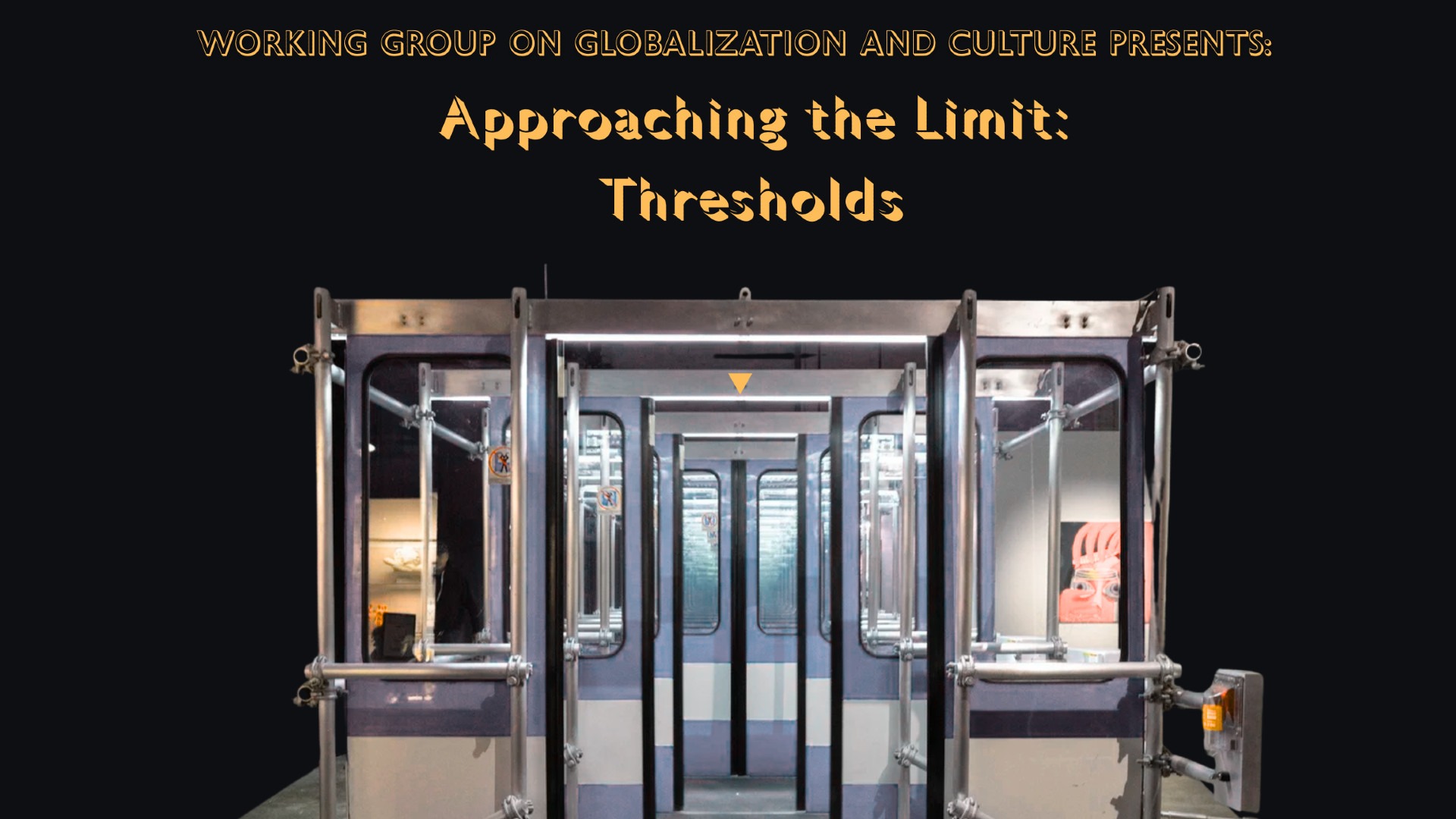
Panel Presentation by the Yale Working Group on Globalization and Culture
Boundary, border, threshold, edge—to approach the limit is to look beyond the familiar landmarks of cultural studies. From geographical borders to epistemological categories, limits and edges initiate the dialectical moment of thought, overturning or transcending the axioms and foundations from which it has sprung. Setting limits to the working day (minimums, then maximums) or to wages (maximums, then minimums, as Marx describes in Capital‘s chapters on primitive accumulation’s legislative efforts) are only the tip of the iceberg. So where do we experience the limits—or limitlessness—of our worlds?
In two linked panels, the Yale Working Group on Globalization and Culture explores the limits and limitations of our world—sensory, spatial, temporal, social, cultural, political. In their geographical and methodological variety, our papers collectively map out the terrain of this keyword, and seek to determine the bounds, so to speak, of studying, theorizing and making culture at the limit.
The first panel, Thresholds: Limit Cases, takes on the exceptions that determine the rule. These limit cases of sound, shock, spirit, and symbol problematize and contest the generic and ideological frames they operate within. Probing the thresholds of perception, we address experience that re-taxonomizes the social and sensorial order. (Panel 2 details here)
Suvij Sudershan asks why the qawwal (a traditional Sufi devotional form that often puts written poetry to music) came to enjoy uniquely prominent position within the global meta-genre of “World Music”? Michelle Chow explores Asian/American transnational ecopoetics, an the literary, philosophic, cultural, and botanical attempts to contend with the post-nuclear environment, by centering around one tree, the gingko. Jane Zhang links the origins of the first aid kit in railway surgery to the broader exchange between emergency protocol and industrial management. Michael Denning takes up Fredric Jameson’s challenge to “political” readings of Marx in the context of recent “republican” re-readings of the political dimension of “Citizen Marx,” reconsidering the limits of and barriers to, the political. And Sam Levin charts the shifting limits of belonging on the global far right as it coalesced in the last quarter of the 20th century.
The Yale Working Group on Globalization and Culture is an interdisciplinary cultural studies research group that has been practicing at Yale University since 2003 Over the years, we have presented our collective work at Crossroads in Cultural Studies the Irish Association for American Studies, the Cultural Studies Association, Historical Materialism, the Marxist Education Project, and the World Social Forum. Past projects have appeared as “Going into Debt,” online in Social Text’s Periscope, and as “Space and Times of Occupation” in Transforming Anthropology. A collective interview regarding “Matters of Life and Death” was published in Revue Française d’Études Américaines. Suvij Sudershan is a doctoral researcher at Yale’s Department of English. His dissertation is on the representation of ground-rent and class-formation in 19th and early-20th century novels from Ireland, England, India, and South Africa. Michelle Chow is a doctoral researcher in Yale’s English Literature and Film & Media Studies program, and a Graduate Fellow of Yale’s Center for the Study of Race Indigeneity, & Transnational Migration (RITM). Jane Zhang is a doctoral researcher in Yale’s Combined Program in Comparative Literature and Film & Media Studies. Her research focuses on the intersecting histories of popular literature and vernacular medicine from the 19th century onwards. Michael Denning teaches cultural studies in the American Studies program at Yale University; among his books are Culture in the Age of Three Worlds and Noise Uprising. The Twofold Labors of Marx is forthcoming from Verso. Sam Levin is a doctoral researcher in the American studies program at Yale University. He studies religion and the global far right in the 20th century.